


Modern enterprises didn’t fail to move fast. They failed to maintain confidence in why things break.
For years, the industry framed operations as a tradeoff between agility and reliability. But modern infrastructure, distributed applications, and now AI have fundamentally changed the equation. Complexity no longer grows linearly—it compounds. Risk and cost scale with it. And while organizations optimized relentlessly for agility, reliability quietly became the bottleneck.
What follows are three observations that ultimately convinced me this problem is finally being approached the right way.
1. Speed Became the Metric. Understanding Paid the Price.
The operational challenge enterprises face today isn’t detection or reaction time. It’s confidence in correctness.
Truth is fragmented across telemetry, tickets, configs, change histories, collaboration tools, and tribal knowledge spread across teams. Most AI-for-operations solutions respond by accelerating analysis without addressing that fragmentation. They apply generic models to deeply non-generic environments and call it intelligence.
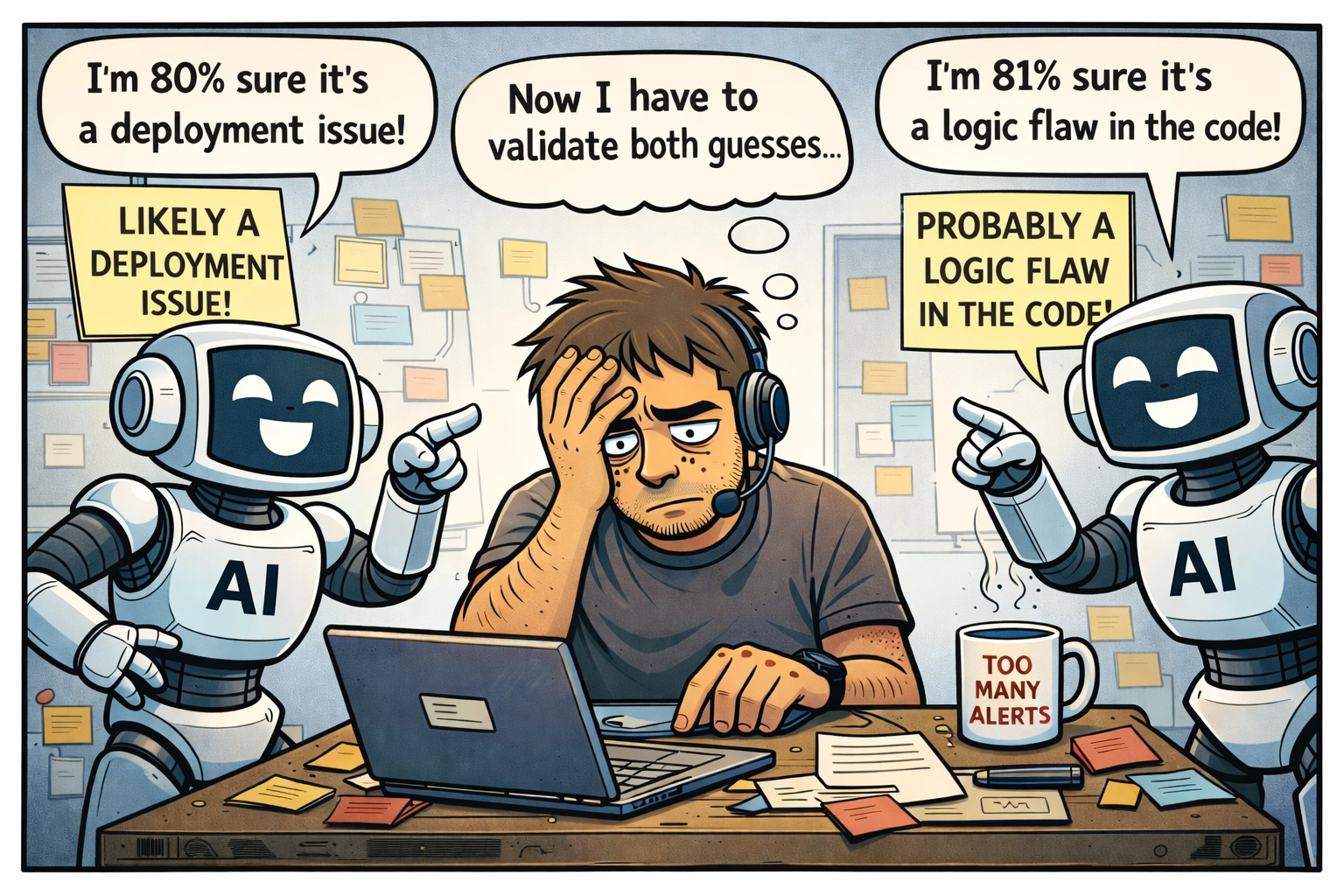
The result is familiar: faster guesses, more alerts, and engineers spending their time validating AI output instead of resolving the incident itself. “Human-in-the-loop” becomes a safety net for inaccuracy. Speed increases. So does the work.
When I was deliberating whether to join Ciroos, what stood out about Ciroos was that they challenged the diagnosis. They didn’t treat complexity as noise to be abstracted away. They treated it as the core reality to be understood. Accuracy wasn’t a feature—it was the foundation. And when systems are built to understand why failures happen, speed follows naturally.
2. Instead of Prescribing How Teams Should Work, Ciroos Expands the System’s Capacity to Handle Reality
Most platforms in this space are opinionated by design. Most platforms in operations are designed to solve narrow, localized problems. High observability costs? Push data into cheaper storage tiers. Too much telemetry flooding tools? Build pipelines to filter and route it. These approaches aren’t wrong—but they’re incomplete.
The same pattern shows up in reliability. The problem was framed as restoring service as quickly as possible, often without understanding the contributing factors that caused the failure in the first place. Speed became the proxy for success, even when confidence in the root cause was low.
Ciroos takes a different approach. Instead of optimizing for faster firefighting or a single workflow, they focus on expanding operational understanding across domains—so reliability improves because the system learns from what actually happened. That understanding compounds over time, helping teams move from reactive response to proactive prevention.
From the earliest design partners—organizations that couldn’t have been more different in industry, infrastructure, or constraints—the outcome was the same. Cross-domain understanding. Context that spans fragmented environments. Federated intelligence that respects local knowledge while compounding insight globally.
Operational complexity isn’t something enterprises can reorganize away. Teams, domains, and systems are inherently fragmented—and for good reasons. So instead of prescribing how work should happen, Ciroos was architected to support how work actually happens.
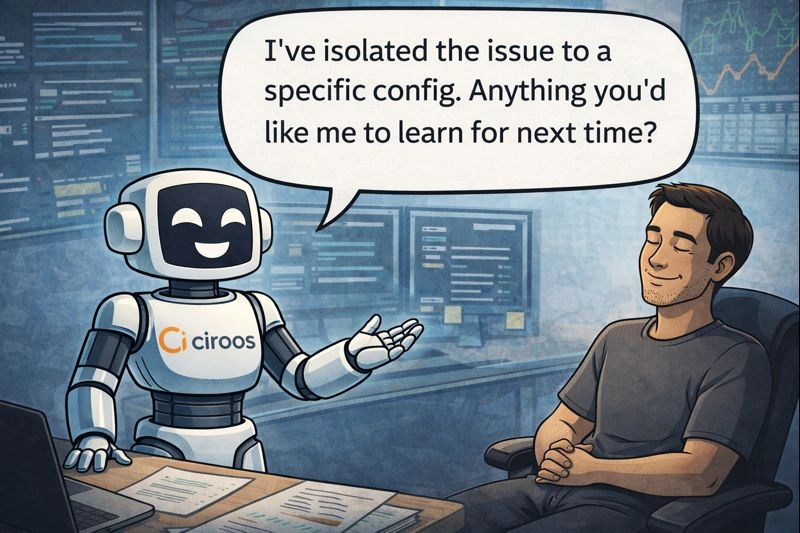
What was eye-opening was watching experienced skeptics—people burned by previous “AI for ops” initiatives—become champions. Not because they were told what to automate or who should be responsible, but because reliability itself expanded without increasing headcount or heroics.
3. Trust Wasn’t a Value They Talked About — It Was Already Operational
The final piece was trust.
In my earliest interactions with the founding team, it was clear these were experienced industry veterans who know this problem intimately. They aren’t chasing attention, valuation milestones, or abstract legacy. They are focused on solving a problem they’ve lived for years—and doing it correctly.
There is deep trust within the team itself. Many of the founders and early employees have worked in and around each other’s circles for more than a decade. That history shows up as customer empathy, low ego, and openness to new ideas. It shows up in how disagreement is handled. In how feedback is invited. In how ownership is distributed.
In just my first few weeks, I’ve had conversations that would have been anxiety-inducing in past roles. Here, they’ve been normal. Healthy. Productive. That’s what trust looks like in practice—and it’s what enables autonomy, rigor, and sustained execution around a singular mission.
Closing Thought
When systems are built for truth, teams move faster and with confidence.
When platforms respect reality instead of prescribing it, reliability scales.
And when trust is operational—not performative—everything else follows.
That’s what convinced me this was different.