Reliability in the Age of AI: From Needles in Haystacks to Business Reliability
Ananda Rajagopal
Read time:
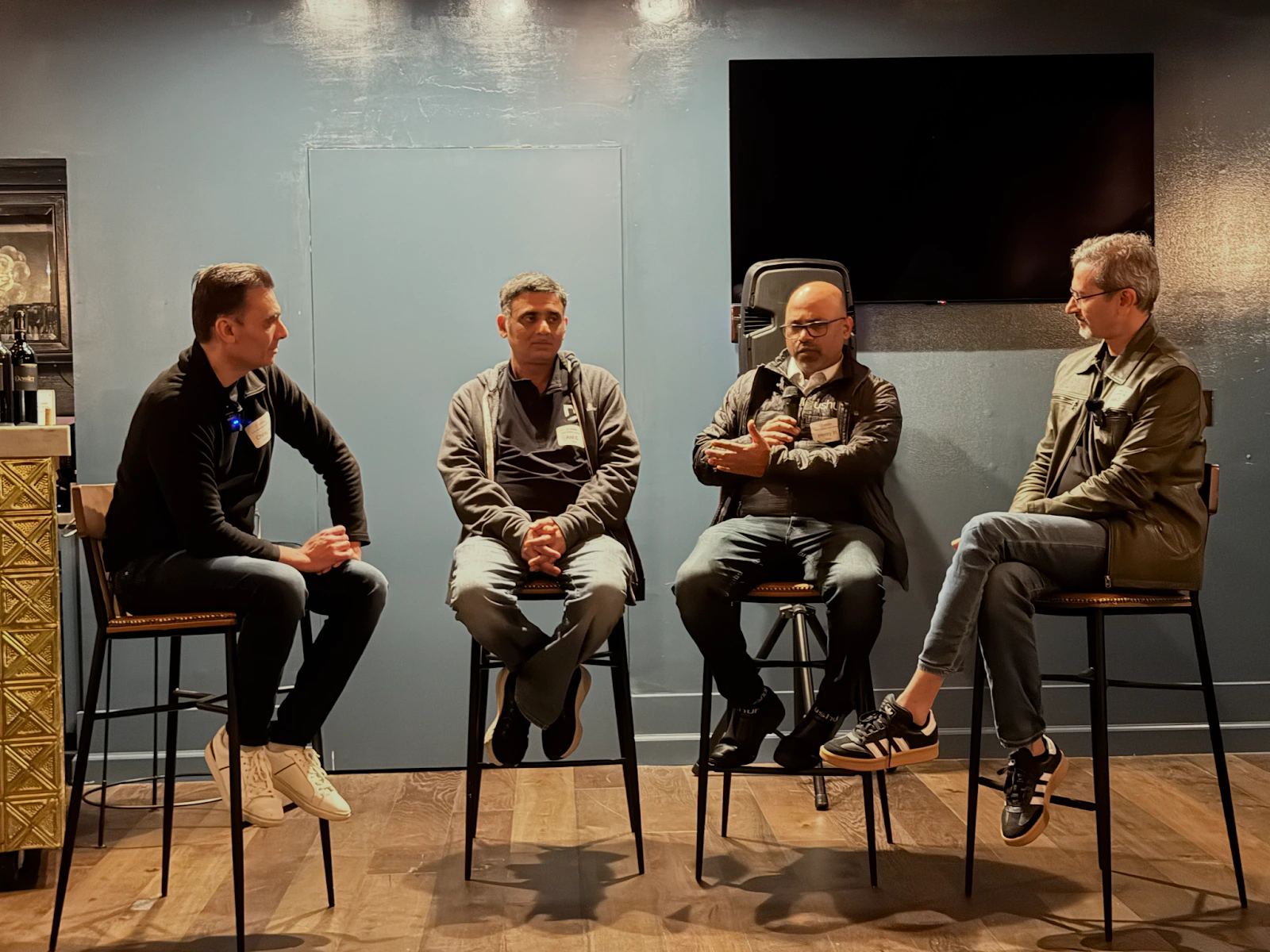
On a rain-soaked evening in San Francisco, a group of reliability leaders gathered for an intimate fireside chat on “Reliability in the Age of AI.” Despite traffic snarls and damp weather, the room was full—clear evidence that the SRE community senses a structural shift underway.
Our panel featured:
- Chirag Mehta, VP and Principal Analyst, Constellation Research
- Anil Chaudhury, AIOps Director, DIRECTV
- Henry Peter, Co-Founder & CTO, Ushur
- Ronak Desai, Co-Founder & CEO, Ciroos
The panel was notable as it captured diverse perspectives:
- An operator’s lens on scaling reliability in high-stakes production environments.
- A platform builder’s perspective on structurally rethinking how AI augments operational cognition.
- A trust-native view on the importance of explainability, shared operational understanding, and calibrated human-AI collaboration.
- An industry analyst’s framing of the broader structural shift underway in enterprise reliability.
What followed was not a theoretical discussion about AI but a candid exploration of how reliability engineering must evolve—structurally, culturally, and technically—in the face of AI-driven complexity. This blog captures the key takeaways from this meetup.
Is This SRE’s “Gutenberg Moment”?
The question was raised early: Is AI in SRE the Gutenberg Moment?
The printing press didn’t just accelerate writing—it democratized knowledge and permanently altered institutions. AI in SRE feels similar. We are not merely automating alert triage. We are changing who (or what) can reason about systems at scale.
The shift is epistemic. Reliability is no longer constrained by human pattern recognition or human capacity alone!
Why Not a 10 Minute (or lower!) MTTR?
One panelist, who had spent 90 minutes navigating San Francisco traffic to reach the venue, noted that a Waymo vehicle would likely have performed better than his human Uber driver. He also noted that e-commerce delivery had advanced from 2-day delivery to next-day delivery to same-day delivery to 4-hour delivery to delivery in minutes!
The analogy was deliberate.
If autonomous systems can navigate chaotic, real-world traffic better than humans and physical item can be delivered in minutes, why can’t we aspire to a 10-minute MTTR?
The barrier is not data availability. It is human cognitive bandwidth.
Humans cannot ingest thousands of telemetry streams, cross-domain dependencies, logs, and collaboration artifacts in real time. AI can.
What Is “Noise”?
We often define noise as “irrelevant alerts.” But one panelist reframed it:
Is noise simply signals a human does not understand?
That reframing matters. Telemetry volume has exploded. Observability strategies driven by FOMO (“collect everything”) have produced environments where we can find 10 needles in 10 haystacks in contrast to finding 1 needle in a haystack before. The question today is to understand which needle actually matters.
The problem is no longer detection—it is prioritization and intent alignment.
Humans and AI: Complementary Strengths
The panel was clear: AI is not replacing engineers. It is redistributing effort.
AI is best at:
- Processing unstructured signals at scale
- Correlating across domains
- Running “what-if” scenarios to plan for the future.
- Removing operational drudgery
Our CEO, Ronak Desai, observed “Looking at logs to analyze issues is like using a slide rule to do math in 2026.” Manual log-diving in 2026 is an anachronism.
Humans are best at:
- Defining intent
- Determining what “good” looks like
- Setting meaningful Service Level Objectives (SLOs) and Service Level Indicators (SLIs)
- Aligning reliability to business outcomes
For example:
- What SLO ensures no viewer sees a freezing screen during the telecast of Super Bowl?
- What latency threshold truly impacts an e-commerce checkout conversion rate?
AI can optimize toward goals—but humans must define the goals.
Organizational Memory: Go Slow to Go Fast
A recurring theme was the importance of capturing tribal knowledge that pervades every organization. Reliability failures often repeat—not because signals were missing, but because organizational memory was.
Going slow to codify prior incident learnings, runbook logic, decision patterns, and expected system behavior … ultimately enables going fast during live incidents.
Without memory, every outage is a first-time event.
AI Is Not a Crutch
A powerful caution emerged: Do not use AI as a crutch. The real craft that SREs and those in production engineering need to master in the age of AI is knowing the right questions to ask. “Prompt is the craft,” as one attendee put it.
One panelist described preparing for the Super Bowl by running structured “what if” simulations against the AI SRE Teammate:
- What if user traffic surges 3×?
- What if a regional dependency degrades?
- What if a specific service hits resource limits?
AI becomes transformative when it helps teams think in counterfactuals—not when it replaces thinking.
From SRE to Business Reliability Engineer
Perhaps the most resonant moment of the evening came from an attendee who coined a new term: Business Reliability Engineer.
The insight was simple but profound. The role of an engineer is not to “go find things”; it is to solve problems that impact the business.
AI agents can remove the drudgery of hunting through telemetry. That frees engineers to move closer to outcomes such as revenue protection, customer experience, brand trust etc.
As one panelist closed: “It is the business (customers) paying your salary. Take care of the business—and choose the right tools to support that objective.”
The Structural Shift
The discussion made one thing clear:
We are moving from tool-centric reliability, alert-centric operations and data-hoarding observability to a future state where there is intent-driven reliability, AI-augmented reasoning and outcome-aligned engineering. This is not incremental improvement; it is a change in how reliability is defined, practiced, and measured.
And judging by the turnout—rain and all—the community knows it!
The age of AI is not about replacing SRE. It is about elevating it.
.png)